A garage door stuck open in Franklin leaves a house exposed the same as an unlocked front door, whether that house sits near Downtown Franklin or out past Berry Farms. Tools, a car, a bike, whatever is inside becomes visible to anyone walking a driveway on Franklin Road or Liberty Pike. The door usually gets stuck open for a small number of reasons, and most of them are things a homeowner can identify safely before anybody touches a wrench.
Stop Pressing The Remote
Stop pressing the remote once the door has refused to move on two tries. Every extra press asks the opener motor to fight something it cannot fight, whether that is a broken spring, a jammed track, or a misaligned sensor. Repeated attempts can burn out the opener itself, turning a spring problem into a spring problem plus a motor problem. Set the remote down, walk out to the garage, and look at the door itself instead of the button.
What Actually Holds It Up
Springs, not the opener motor, carry the actual weight of a garage door in Franklin homes. Most subdivisions around Cool Springs and Berry Farms use a torsion spring set over the header, while some older houses near Downtown Franklin still run extension springs along the upper tracks. If that spring lets go, the opener has nothing left to lift against, and the door will sit wherever gravity and the tracks leave it, often stuck open.
Never Force It By Hand
Do not pull, shove, or lean on the door to force it shut. A standard garage door weighs well over a hundred pounds, and a working spring is what makes that weight manageable by hand. If the spring has already failed, there is nothing absorbing that weight, and the door can drop fast on fingers, feet, or a bumper below it. Leave the door where it is until the cause is known, even if that means the garage stays open a while longer.
Find The Emergency Release
Look near the top of the track for a hanging cord with a handle, usually red. That cord is the emergency release, and pulling it drops the door out of automatic mode into manual mode. In Franklin homes from Cool Springs to Westhaven, this cord sits close to where the trolley meets the rail. Pull it straight down and the door should move freely by hand, which tells you whether the opener or the door itself is the problem.
Check For A Broken Spring
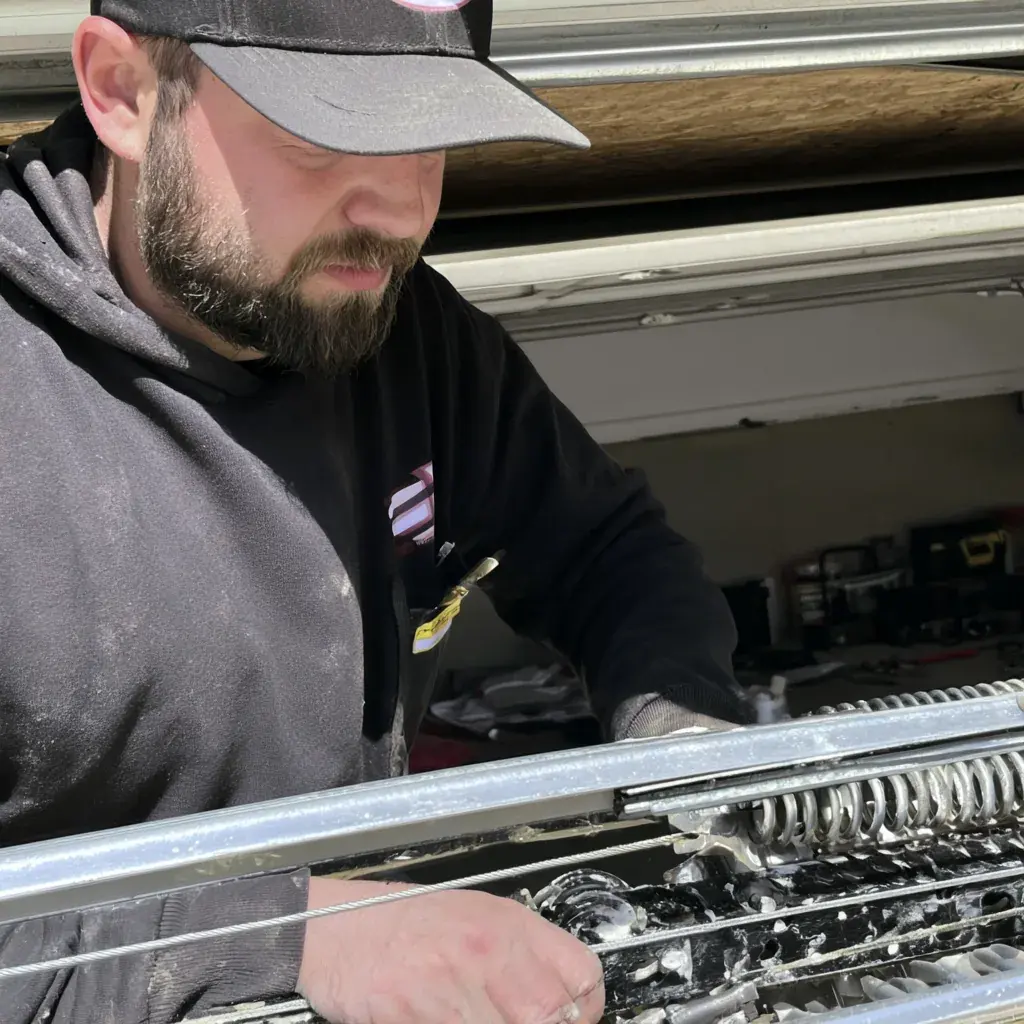
Look at the coil above the door frame before you touch anything else. A torsion spring with a visible gap, or one twisted loose from its cable drum, has likely failed. On homes with side-mounted extension springs, common in older sections near Franklin Road, a snapped coil usually hangs loose or dangles unevenly from its pulley. Either way, do not reach toward the spring or its cable. This is stored tension, and it lets go without warning.
Secure The Opening Instead
When the door will not close tonight, shift the plan from fixing it to covering the opening. Move anything worth taking indoors, and if the opener has a manual release, most homeowners find pulling that emergency release cord lets the door be walked down by hand into manual mode, provided no spring is broken. With a broken spring, skip that step entirely and instead block the opening with a sturdy panel, a parked vehicle, or whatever secures the opening until daylight.
Rule Out The Sensors
Any opener made after 1993 has to meet a federal standard called UL 325, which requires the door to reverse if it senses resistance and to stop moving if a photo eye beam near the bottom of the track gets broken. If your Franklin home still has an older opener without those sensors, treat the door with more caution, since it will not stop itself the way a newer one will.
When A Cold Snap Is To Blame
Franklin does not see the deep freezes some regions get, but a sharp cold snap can still stiffen weatherstripping and thicken old grease inside the track. A door that has run fine for years can bind up on a night when temperatures drop hard and fast. This shows up as a door that starts to close, hesitates, and reverses, rather than one that fails outright. Warmer daytime temperatures often loosen things back up, but a spring already weakened by age can still snap under that added strain.
What Not To Do Tonight
Do not pull on the door with more force because it feels close to closing. A broken spring means nothing is holding that weight back, and a sudden give can pull a shoulder or drop the door on a foot. Do not tape or prop anything under the panel to force a seal either. If children or pets are in the house, keep them away from the opening until the door is either shut by hand slowly or blocked off some other way.
Why Timing Makes It Worse
A stuck-open door matters more on some mornings than others. A Franklin household heading out toward Cool Springs for work or dropping kids off before doubling back later in the day may leave the garage exposed for hours without anyone home to watch it. A door that fails right before a full day away is a longer window of exposure than one that fails in the evening, when someone is still around to secure the opening properly.
Let Someone Else Look At It
Once the opening is blocked off and the door is no longer being forced by hand, the real diagnosis still has to happen. Springs, cables, and rollers wear on their own timeline, and a homeowner in Grassland or Fieldstone Farms guessing at torque from a ladder is how a minor repair turns into a trip to urgent care. Call the licensed pros we connect you with, describe what you saw and heard, and let them confirm what actually failed before anyone touches the hardware again.
Dealing with this in your home?
Franklin's clay soil swells after storms rolling through Cool Springs and settles again once things dry out near the Harpeth River, and a garage door track anchored to a slab or crawl space foundation shifts right along with it. Homeowners near McKay's Mill or off Del Rio Pike often notice the door binding on one side first, right when the ground moves.