What a Humid Summer Does to Tracks
New construction near Ladd Park and Berry Farms keeps fine dust moving through the neighborhood air, and it settles into the bottom track over weeks. Combined with the limestone grit already common in Franklin driveways, it builds up at the low point until a roller finally catches on it.
Homes on the older, established lots around Sullivan Farms sit on crawl spaces, and small ground movement over the years can nudge a track bracket loose without anyone noticing. It usually announces itself as a grinding noise right where the door starts to hang up.
Bottom seals wear from contact, not age alone. Every open and close drags the rubber across the same few inches of concrete, and grit embedded in that strip works like sandpaper over months. Replacing the seal costs far less than the water and drafts it was stopping.
Matching a Door to an HOA Design Standard
- Pattern
- Catches or grinds at one fixed spot on every cycle, never along the whole track length.
- Cause
- Limestone dust packed into the track, a bracket rocking free of the jamb, or a jamb that has edged out of plumb.
- Risk
- Gets sharper and louder over weeks as grease thickens; almost never clears up on its own.
- First Check
- Track wall and roller at the exact catch point first, then every bracket along the rail, then jamb alignment.
- Left Alone
- A roller jumping the rail, or the opener straining hard enough to strip a gear.
- Availability
- Dust from ongoing construction around growing subdivisions tends to build steadily rather than after one storm, so binding creeps in over weeks. A cold snap in January can thicken old grease at that same spot and make a mild catch turn into a hard stall overnight.
- Service Radius
- an estimated $159–$649
Reading a Door That Has Started to Bind
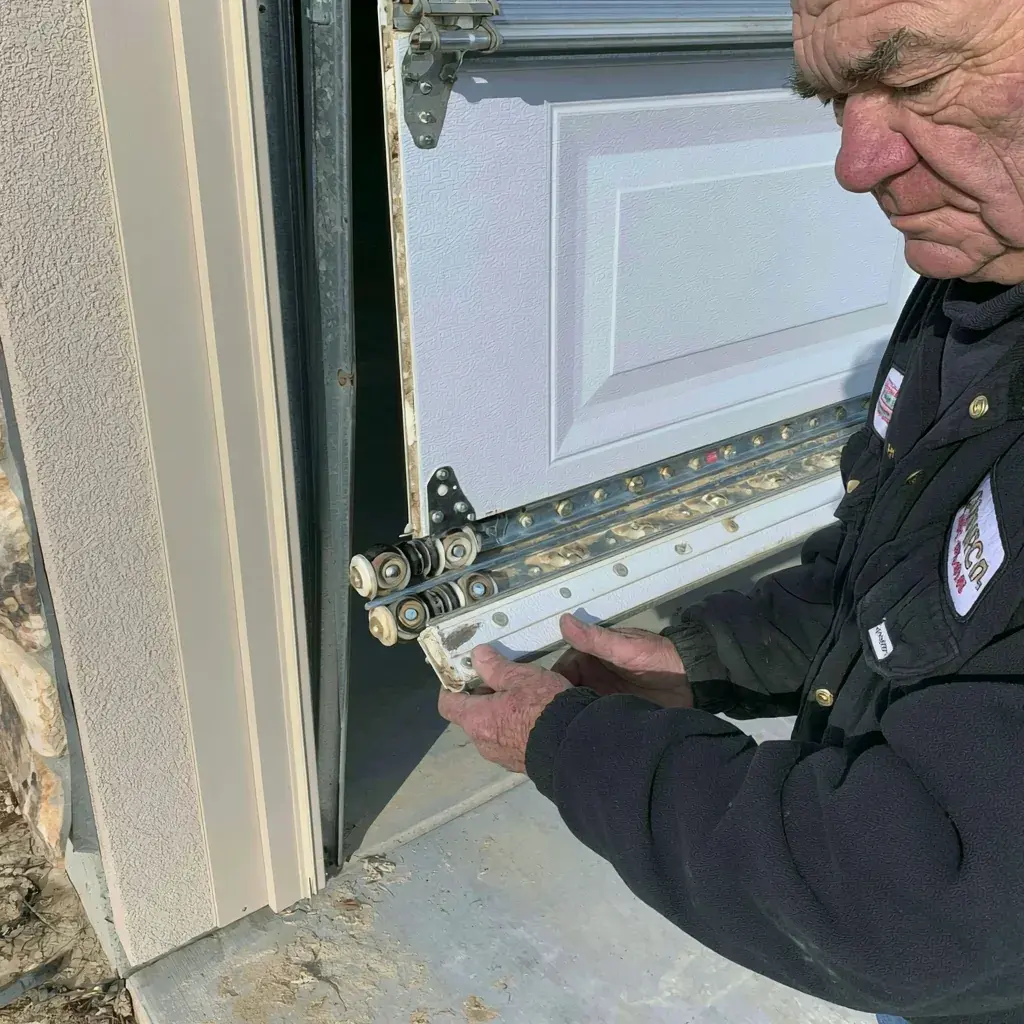
Binding gets mistaken for a limit or spring fault because both can stop the door short. A limit or spring issue tends to stop travel gradually or reverse near the top or bottom, not at a repeatable mid-track spot. Binding hits the exact same mark, cycle after cycle, right where a bracket or the track itself has moved. Watch a full open-and-close cycle. A door that hitches at the identical point every pass, then moves freely again, is binding. A section that looks uneven the moment the door is fully down, moving or not, points to a sagging panel instead, a different fix entirely.
Reading Your Door Before It Fails
The licensed pros we connect you with focus on the exact spot where the door hangs up in Franklin, testing whether the track bracket has pulled loose from the jamb, whether construction dust has packed into the rail, and whether the jamb itself has edged out of true.
The pros check the spot the door binds in the tracks first, since it repeats there every run. They also cycle the door fully to see if it stalls or the opener strains right at that mark before touching a bolt.
A garage door in Franklin earns its keep through humid summers and cold snaps alike, and every temperature swing works on the same springs, cables, and hinges. Homes built decades apart carry different frames and different wear, so a fix that suits one house can miss the mark on another entirely.
SEAL CONDITION AND WHAT DRIVEWAY LENGTH DOES TO IT
| How It Shows Up |
What To Do |
|---|
| Openers rarely fail the moment they're pushed too hard once. It's the years of straining against a spring that's lost tension, or a track that's a half-inch out of true, that finally burns out a motor. By the time it stops responding, the wear was already well underway. | Homeowners often wait on a garage door problem because the door still technically opens. That gap between working and working well is where small issues turn expensive, since a strained opener or an unbalanced spring keeps compensating until something finally breaks under the load. |
| Homes on crawl spaces move a little as clay soil shifts with the seasons, and that small movement can pull a garage door frame just out of square. The door still looks fine. It just does not sit right anymore, and the track knows before you do. | Homes built at different times settle differently, and a frame that has shifted even slightly can throw a door off its track. The door still looks straight from the driveway, but the rollers are fighting the frame every time it moves, which wears the opener and hardware faster than normal use would. |
| A spring that's been fine for years can still snap without warning after a hot, humid stretch bakes the lubricant out of the coils. Torsion springs hold real force under tension, so a sudden loud bang or a door that won't lift evenly is reason enough to stop using it and call someone. | Garage door hardware doesn't fail because the calendar says so. It fails because a bolt worked loose, a roller wore thin, or a sensor drifted out of line, and those things happen on their own schedule. A door that opened fine yesterday can jam mid-cycle today. Catching the small noise before it becomes a stuck door saves money and a wasted morning. |
The Part Where Guessing Gets Expensive
Look for the same catch point on every pass, not a drag along the whole track. Clear visible dust from the bottom rail with a dry cloth and check whether the nearby bracket wiggles by hand. Do not force the opener through it repeatedly or pull on a bent garage door track.
What Karst Ground Does to Door Alignment
Door binding in the tracks means resistance hits one fixed spot rather than spreading evenly, so the opener keeps pulling after the roller stops there. That strain is often what shows up later as a frayed cable or a section that starts sagging near the bind point.
Not sure it's worth fixing? Ask first.
Treating door binding in the tracks usually runs an estimated $159 to $649. That is a budgeting figure, not a price. These figures cover the working parts and the labor to fit them: springs, cables, rollers, hinges, bottom seal, opener components, panel repair. Anything structural is looked at separately before a number means much, whether that is a jamb gone soft where it meets the slab or a settled header on one of the older houses near the downtown square. Ask what the visit charge is, and get the scope in writing. Full bands and what moves them are on the pricing guide, and the service that handles this is Off-Track Garage Door Repair.