Two homeowners on the same Franklin street can order garage doors the same week and end up with completely different faces. One picks raised panels and hinges meant to look like they swing open by hand. The other picks a flat, quiet face with a few pressed grooves. Neither door actually operates any differently once the torsion spring and opener take over. The pick comes down to what the rest of the house is already saying, and Franklin has enough older homes and newer ones that both answers show up block to block.
What Carriage House Overlay Means
A carriage house overlay is hardware and panel shape layered onto an ordinary sectional door. Raised rectangles break up the face, and strap hinges plus a hasp or two sit bolted across the seams like they belong to a hinge that swings the whole door open by hand. It reads as an old coach entrance from the street. Underneath, the door still rolls up on tracks the same way a plain one does. The overlay only changes what a person driving past registers, not how the door moves.
What A Flush Panel Is
A flush panel keeps the face in one plane. No raised sections, no bolted hardware, just a smooth surface sometimes interrupted by a couple of wide horizontal grooves pressed across it for a little shadow line. It reads plainer from the curb, closer to what shows up on a lot of newer builds around Cool Springs or Berry Farms. Some flush doors skip the grooves entirely and go completely smooth, which reads even quieter next to a house with simple trim and a plain roofline.
How The House Decides It
A house already carrying some age or texture, an older place near Old Town Franklin or a home with stone accents off Del Rio Pike, tends to hold an overlay door well because the hardware has something to answer to. A newer subdivision house in Westhaven or McKay's Mill, with simpler siding and a more uniform roofline, usually reads better with a flush face that does not compete with anything. The house is not making a rule, but the two styles clearly favor different kinds of homes.
Where Glazing Changes The Read
Glazing sets the tone before anyone notices the panel style underneath. A carriage house door in Westhaven or Founders Pointe often carries stacked square lights near the top rail, mimicking an old strap hinge coach entry, and that grid throws a shadow line across the face by mid-afternoon. A flush panel skips that entirely, running one plain window band that keeps the overlay look off the door and lets the garage read as part of the house instead of a feature.
Hardware That Actually Moves
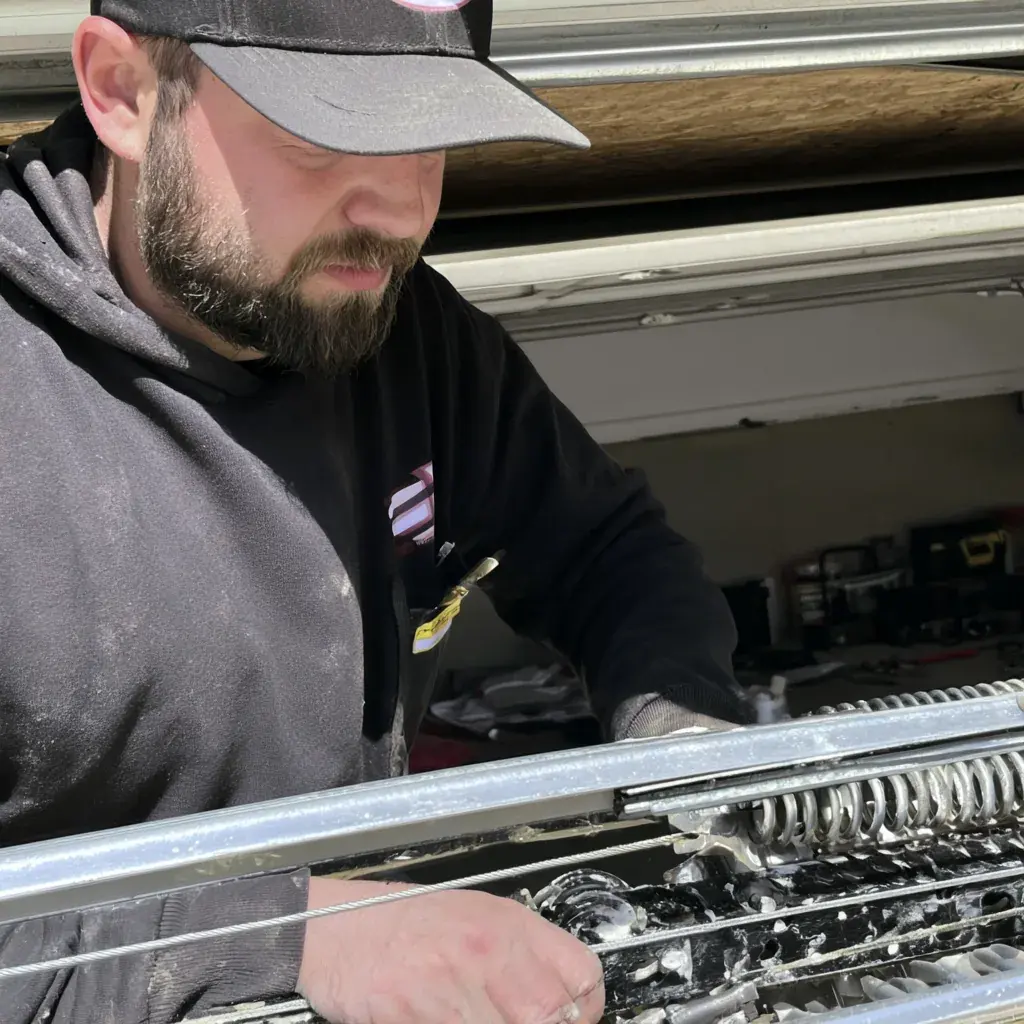
The strap hinges bolted across an overlay face do not lift anything. They sit flat, fastened for looks only, on a panel that never swings open on its own hinge. The torsion spring overhead, the rollers riding the tracks, and the bottom bracket holding tension are what actually raise the door, and none of that changes based on which face gets bolted on top. A homeowner in Franklin choosing a look should know the moving parts stay identical either way.
Historic District Review Matters
A door on a house inside the Franklin Historic District near Main Street or Columbia Avenue may face a different review process than one going up in a newer subdivision, since the city treats exterior changes on historic properties differently. A homeowner near Old Town should check with the city before ordering either style, while a house in Governors Club or Avalon is more likely governed by an HOA architectural committee instead.
Weather Treats Both Styles Alike
Humid summers and the occasional hard cold snap work on both door styles the same way, since neither carriage house trim nor a flush face changes how the panel handles moisture or temperature swings. Homes closer to the Harpeth River or its tributaries carry a separate concern about water reaching the bottom panel during heavy rain, and that risk has nothing to do with which face is mounted on the door.
Insulation Is Its Own Decision
Insulation level is chosen separately from which face gets picked, and neither style changes what the door does thermally on its own. A garage that sits closer to the Harpeth River or backs up to a shaded lot in Fieldstone Farms may hold more moisture through a humid Franklin summer, which argues for a better insulation tier regardless of whether the front looks like an overlay or a flush panel. Picking the look first and the insulation as an afterthought usually means paying for foam that does not match the actual garage.
Resale And Buyer Expectations
Buyers touring a listing in Governors Club or Legends Ridge tend to notice an overlay door faster because the hardware photographs as an upgrade, even when the flush door next to it cost about the same. In a subdivision where every house already has a flush panel, though, an overlay door can look like it does not belong, and a flush door blends in without drawing a second look. What sells in Franklin depends more on matching the block than on either style being the better one.
Cost Differences Worth Knowing
Overlay hardware is why carriage house doors cost more up front. Fitting strap hinge accents and raised trim across a flush panel takes extra material and more careful labor than a smooth face ever needs. In Berry Farms or Sullivan Farms, where lots run newer and driveways sit close to the street, that price gap often buys curb presence, since a plain flush panel can look like builder-grade stock next to neighboring carriage house fronts along the same block.
Matching the Style to the House
Neither style is a wrong pick standing on its own, and the better fit has more to do with the house and the street than any hard rule. A newer subdivision off Carothers Parkway can carry either look without friction. A home closer to Main Street or the Harpeth River, where the architecture already leans older, tends to sit better with the carriage house face. Walking the driveway and looking at what the neighbors already run is a better guide than picking from a brochure.
Dealing with this in your home?
Franklin's clay soil swells after storms rolling through Cool Springs and settles again once things dry out near the Harpeth River, and a garage door track anchored to a slab or crawl space foundation shifts right along with it. Homeowners near McKay's Mill or off Del Rio Pike often notice the door binding on one side first, right when the ground moves.