Understanding Extension Springs and Cables in Franklin, TN
Why stretch springs still lift doors across older Franklin neighborhoods.
Extension springs stretch along the horizontal tracks on either side of the door, lifting it as they contract, rather than twisting on a shaft above the opening. Found mostly on older single-car doors and garages with low headroom that cannot fit a torsion shaft.
How the Spring Actually Lifts the Door
An extension spring lifts by stretching along the horizontal track above the door, not by twisting on a shaft. In Franklin garages with low headroom, this matters at the top of the opening: torsion hardware needs clearance above the door that older homes near Downtown Franklin and Old Town often don't have. Extension springs tuck along the track itself, so they fit ceilings that leave almost nothing to spare.
Each spring anchors at the back of the track and connects, through a pulley, to a cable running down to the bottom bracket. As the door closes, the spring stretches and stores force; opening lets it pull back and help lift. That pulley and cable arrangement is why extension setups show up so often in Franklin subdivisions with garages built before torsion became the standard choice for tighter headroom.
The tell is what moves when the door travels. A torsion spring sits still on a shaft centered above the opening while the shaft itself does the turning. An extension spring does the visible work: it lengthens as the door lowers and pulls back in as the door rises. Anyone standing in a garage in Fieldstone Farms or McKay's Mill watching the coil stretch and relax with each cycle is looking at an extension system, not torsion.
The Safety Cable's Real Job
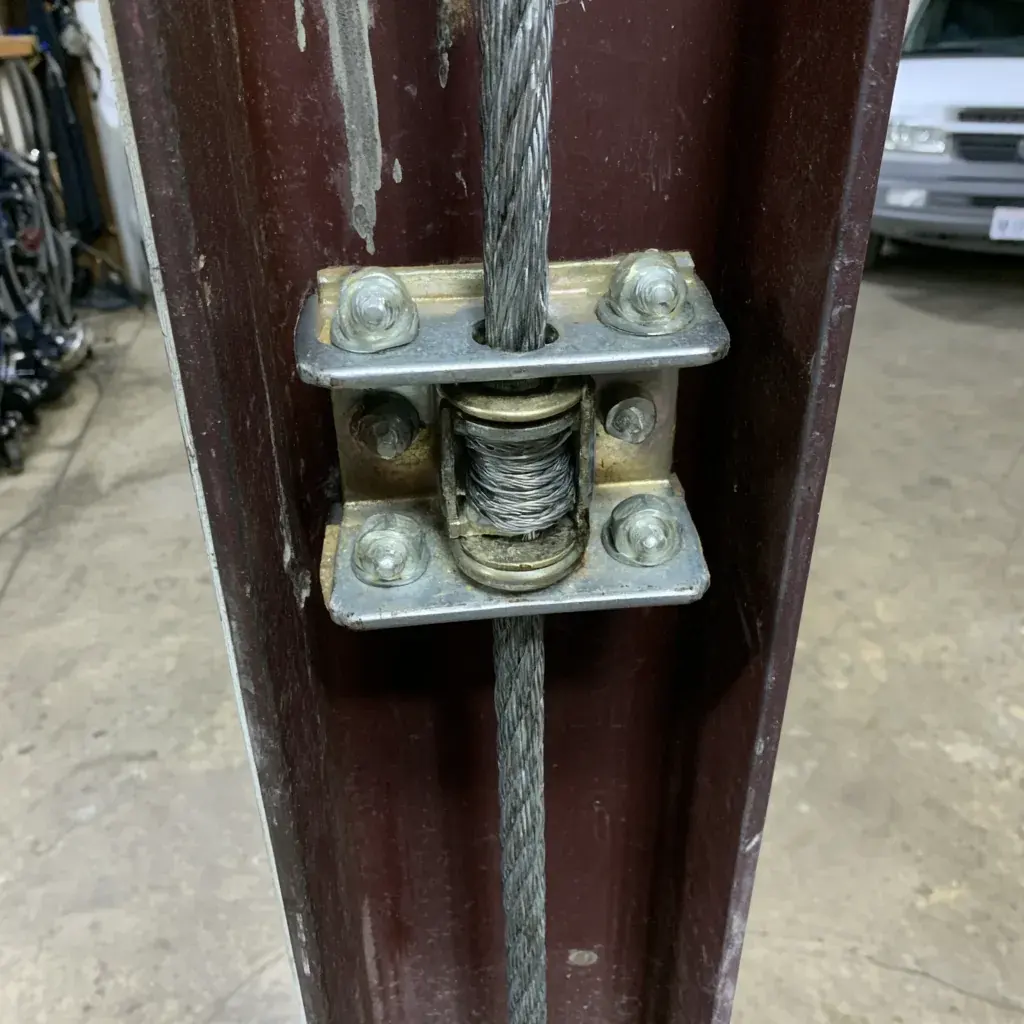
Picture the extension spring letting go under tension, snapping free of its mounts. Without restraint, that stretched steel becomes a projectile aimed straight down the garage. A safety cable runs the length inside each spring, pinned at the header and at the track bracket, so a broken spring stays confined to a few inches of travel instead of crossing the garage in Westhaven or Fieldstone Farms. Homes without this cable installed are running older hardware than current safety standards allow.
That kind of failure is not unusual for a part worked this hard. An extension spring spends its whole service life stretched near its rated capacity, repeating that same motion every time the door cycles, for years on end in homes across Williamson County. When the steel finally gives out, it happens without warning, and a spring under that much stored tension becomes a fast-moving piece of metal instead of a quiet mechanical part.
Federal rules for extension spring installations have required this cable since the 1970s, so most systems still running in Williamson County already carry one. What a technician finds missing is usually on an older door near Downtown Franklin that had a spring swapped out at some point without one added back, or a farmhouse-era garage off Del Rio Pike that predates the requirement entirely.
Extension vs. Torsion in Daily Use
Extension and torsion springs fail in different ways, and that changes what a homeowner in Franklin notices first. A torsion spring often gives some notice, a door that gets heavier over weeks as the coil loses tension. An extension spring tends not to announce itself the same way; it can hold its stretch right up until the moment it snaps, so the first sign is often a loud noise and a door that will not lift.
Extension hardware also carries wear points a torsion setup never has. The pulley wheel can groove or bind in its bracket after enough trips up and down the track, and the S-hook linking spring to pulley can stretch open or wear thin at the bend over time. None of that hardware exists on a torsion system, where the spring itself sits fixed on a shaft and the moving parts are limited to the shaft, cable drums, and bearing plates.
Deciding on a Torsion Conversion
Conversion swaps a garage's pulley-and-cable system for a torsion shaft, and it comes up often in Franklin's older homes downtown and in crawl-space houses out toward Grassland, where the ceiling framing was never built with a shaft in mind. Whether it works depends on the inches between the top of the door track and the ceiling. A torsion setup needs clearance that older Franklin garages, especially those built before slab-on-grade became the norm, sometimes just do not have.
When there is room, Franklin homeowners weighing conversion are usually reacting to a spring that already failed once, not chasing an upgrade for its own sake. A torsion shaft removes the pulleys, the S-hooks, and the stretch-and-release cycle that wears extension springs down. It also changes how a broken spring behaves, since a torsion spring stays contained on its shaft instead of releasing tension along an open track above the door.
Extension Spring Basics
- Torsion springs live on a rod above the closed door and lift by winding tighter as the door goes down. Extension springs sit along the horizontal tracks on either side, stretching outward as the door lowers and pulling back as it rises. Franklin garages built decades ago, from Grassland to parts of Downtown Franklin, often still run the extension setup.
- Extension springs need real headroom above the horizontal track to stretch fully; low-clearance garages near Cool Springs and older Franklin lots often can't fit a torsion shaft instead. Cycle life runs shorter than torsion, pulleys and S-hooks add wear points, and every extension spring needs its own safety cable to be considered a finished install.
- Older homes near Grassland and Old Town often still run the original extension spring setup installed when the garage was built.
- Many Franklin homes built before the 1980s, especially around Old Town and downtown, kept extension springs simply because the garage ceiling never had room for a torsion bar overhead.
- A torsion conversion adds a shaft, bearing plates, and drums across the header, changing how the door hangs, not just the spring.
- Watch the pulley bracket and S-hook where the cable meets the track bracket. Years of rust and flexing wear that metal thin long before the spring itself gives out.
Frequently Asked Questions
Why do the springs run along my garage door's side tracks?
That's an extension spring setup, common on older single-car garages around Franklin, including homes in and near the historic downtown core built before torsion shafts mounted above the opening became standard. Low headroom above the door opening is often the reason a builder chose side-mounted springs in the first place. Newer subdivisions across Williamson County, including Westhaven and Fieldstone Farms, more often use torsion springs on a shaft instead.
What's that cable running through my spring for?
That's the safety cable. It threads through the spring and anchors independently, so it isn't doing any lifting under normal use. If the spring breaks, that cable is what stops the pieces from flying loose in the garage. If your door in Cool Springs or Berry Farms doesn't have one on both springs, that's worth having a pro check and add.
Is switching from extension to torsion springs worth it?
It depends on the garage. If headroom above the opening allows a torsion shaft, converting removes the pulleys, S-hooks, and stretched springs that wear over time, trading them for a single shaft-mounted system with fewer moving parts. If headroom is tight, as in some older Franklin garages, torsion hardware may not fit without other changes, and keeping extension springs with a proper safety cable in place is the more practical route.
Ready to have your springs looked at?
The licensed pros we connect you with can check your extension springs or quote a torsion setup for your Franklin garage.
Call (615) 759-0548